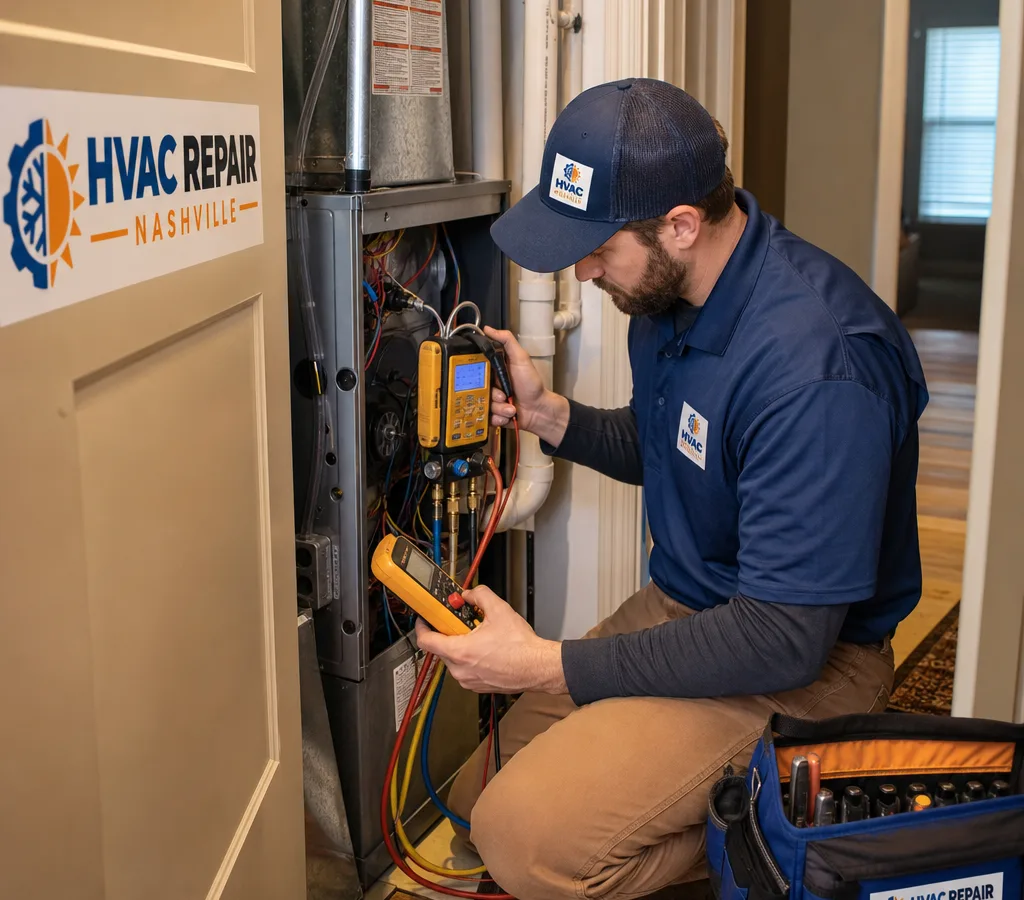
HVAC technician diagnosing a residential furnace in a Nashville-area utility closet
Furnace repair in Nashville, TN

Nashville Furnace Repair

Get heat back fast with a careful diagnosis, a clear repair plan, and skilled HVAC techs who work on gas and electric furnaces across Nashville.

✓Gas furnace diagnostics
✓Electric furnace service
✓Safety circuit checks
✓Performance verified
Reliable heating repair

Fast, reliable furnace repair when your heat quits

When your system will not heat, cycles on and off, or starts making new noises, you need a technician who can pinpoint the cause quickly and fix it correctly. HVAC Repair Nashville handles Nashville furnace repair for the problems homeowners notice most: no heat, weak airflow, burning smells, rattling or squealing, and error codes.

In Middle Tennessee, winter cold snaps can turn a small furnace issue into an urgent one overnight. We focus on the root cause, not just resetting the unit and hoping it holds. You get what failed, why it failed, what it takes to repair it, and what we recommend to prevent a repeat breakdown.

If you are also dealing with a broader heating and cooling issue, our team supports HVAC repair in Nashville for system-level troubleshooting, airflow problems, and control issues that affect both heating and cooling.
Request a Callback
Warning signs explained

Common furnace problems we repair (and what they usually mean)

✓

No heat or short cycling

Often tied to a dirty flame sensor, a failing igniter, a limit switch opening from restricted airflow, or thermostat/control issues. We test the safety circuit, verify combustion and temperature rise, and correct the underlying trigger.

✓

Odd noises: rattling, booming, squealing

Loose panels or duct connections can rattle, while squealing can point to blower motor or belt and bearing issues. A delayed ignition “boom” is a safety concern that needs immediate inspection.

✓

Weak airflow or cool air at vents

Common causes include clogged filters, blower capacitor or motor problems, duct restrictions, or a dirty evaporator coil. We measure static pressure and airflow to confirm the cause.

✓

Furnace keeps tripping or shutting down

The cause may be a clogged condensate drain, pressure switch fault, flame rollout or limit trip, or electrical issue. We complete a safety check before returning the unit to service.

✓

Burning smell or gas odor concerns

A brief dusty smell at first heat can be normal. Persistent burning, a strong odor, or symptoms such as headaches should be treated as urgent. We inspect heat exchanger conditions, venting, and gas connections as applicable.

✓

Thermostat shows heat but furnace will not start

This can indicate low-voltage control issues, a failed transformer, pressure switch fault, or blower door switch problem. We confirm call-for-heat signals and trace the circuit safely.

Request a Callback
Testing before repair

What to expect from our furnace service and repair visit

A good repair starts with a structured diagnosis. For furnace repair in Nashville, we typically:

  • Confirm the symptom—no heat, short cycling, noise, odor, or weak airflow—and gather recent history such as filter changes or power outages.
  • Check thermostat inputs and control-board fault codes, then verify safe operation of the ignition sequence: inducer, pressure switch, ignition, flame sense, and blower.
  • Inspect high-wear parts such as igniters, flame sensors, capacitors, blower motors, and relays, testing components rather than guessing.
  • For high-efficiency condensing furnaces, inspect intake and exhaust venting, condensate drains and traps, and pressure-switch tubing because restrictions can lock out heat.
  • Verify performance after repair, including temperature rise, stable flame, proper venting and combustion air, and safe limit operation.

Many homes in neighborhoods like Sylvan Park and Green Hills have a mix of older and newer HVAC equipment, and we see everything from standard-efficiency furnaces to high-efficiency systems with PVC venting. The repair approach changes depending on your furnace type, so we identify what you have first and then proceed with the right checks.

Request a Callback
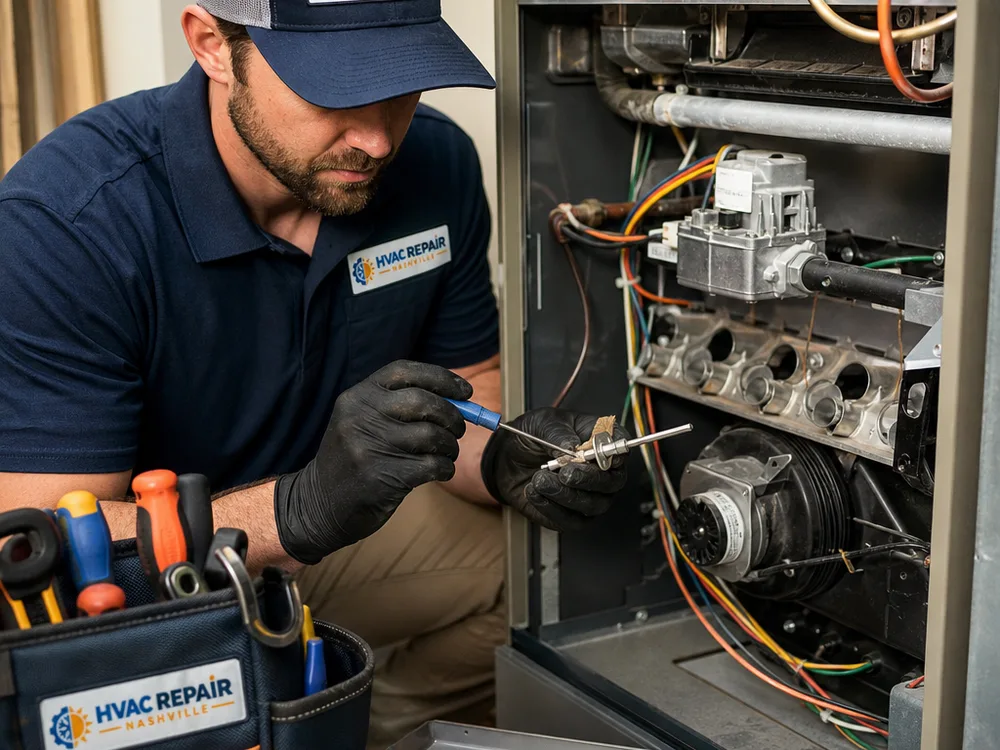
Technician cleaning a furnace flame sensor and inspecting the igniter assembly
From no-heat call to verified repair

Our Nashville furnace repair process

01

Schedule and arrival window

Tell us what the furnace is doing—or not doing—any error codes, and whether you smell gas or burning. We prioritize safety concerns and no-heat situations.

02

Diagnosis and safety checks

We verify the call for heat, inspect the ignition sequence, and check the safety circuit. If anything indicates an unsafe condition, we stop and explain the next step before proceeding.

03

Clear repair options

You get a straightforward explanation of what failed and what it takes to fix it. When there are multiple paths, we lay out the tradeoffs.

04

Repair and verification

After the fix, we run the system through a full heat cycle, confirm stable operation, and check items that commonly cause repeat failures, including airflow restrictions and condensate drainage on high-efficiency units.

Request a Callback
Repair pricing

How Much Does Furnace Repair Cost in Nashville?

Most Nashville furnace repair visits typically land around $150 to $650 total, depending on the problem and the parts involved. A minor repair like a flame sensor cleaning or a capacitor replacement is often on the lower end, while a control board, blower motor, or inducer motor repair can run $500 to $1,500+.

Your final price depends on the furnace type—gas, electric, or high-efficiency—the specific failed part, diagnostic time, and whether there is related damage such as overheated wiring or airflow issues. Exact cost is confirmed after the on-site diagnosis.

Request a Callback
Customer experiences

Careful diagnostics and clear furnace repair guidance

“Our furnace kept shutting off every few minutes. The tech explained what the limit switch was reacting to, found a real airflow issue, and fixed the cause instead of just swapping parts. Heat has been steady since.”

“We woke up to no heat and a flashing error code. They diagnosed it quickly, showed us what failed, and had the furnace running the same day.”

“I appreciated the safety focus. They checked the venting and the burner area, then walked me through what was normal and what was not before finishing the repair.”

Common questions

Furnace repair FAQs for Nashville homeowners

Straightforward answers about no-heat calls, short cycling, furnace safety, repairs, and replacement decisions.

Do you handle emergency no-heat furnace repair in Nashville?+

Yes, we prioritize no-heat calls and safety concerns and work to restore heat as quickly as scheduling allows. If you smell gas or suspect a carbon monoxide issue, treat it as urgent: leave the home if needed, and have the gas supply addressed by the appropriate utility or emergency resources before restarting the furnace.

My furnace turns on, then shuts off after a minute. What causes that?+

Short cycling is commonly caused by overheating from restricted airflow, a dirty flame sensor, or a safety switch opening during the ignition sequence. The right fix depends on which safety is tripping, so we test the sequence and confirm airflow and temperature rise before replacing parts.

What should I check myself before scheduling furnace repair?+

Check that the thermostat is set to Heat and has fresh batteries if needed, verify the furnace switch is on, and replace a visibly dirty air filter with the correct size. Also confirm exterior intake and exhaust PVC pipes are not blocked. If breakers keep tripping or burning smells do not clear quickly, stop and have a technician inspect the system.

Do you repair both gas and electric furnaces?+

Yes, we service both gas and electric furnaces, and the diagnostic approach changes based on the heat source and safeties. Gas furnaces involve ignition and combustion safety checks, while electric furnaces more often involve sequencers, contactors, relays, and heating-element testing.

Is it safe to keep running a furnace that is making a new banging or booming noise?+

No. A sudden boom at startup can indicate delayed ignition, which is a safety concern that should be inspected promptly. Rattles can be minor, but any loud bang, repeated boom, or smell paired with noise should be treated as a stop-and-check situation.

How long does a furnace repair appointment usually take?+

Many repairs are completed in 1 to 2 hours when the issue is straightforward and parts are available, but complex intermittent problems can take longer. High-efficiency furnaces may add time for venting and condensate diagnostics because restrictions there can mimic component failures.

Will you tell me if replacement makes more sense than repair?+

Yes. If the furnace has major component failures, repeated breakdowns, or safety-related concerns, we will explain your options clearly. The decision usually comes down to repair cost, the condition of major components, and how reliably the system can be expected to run through the rest of the season.

Restore safe, reliable heat

Need furnace repair today?

Tell us what your furnace is doing, any thermostat messages or flashing lights you see, and how long the problem has been happening. We will schedule a diagnosis and get you a clear repair plan to restore safe, reliable heat in your Nashville home.